SOC 2 Gap Analysis: What to Fix First
A practical guide to scoping, mapping controls, prioritising gaps, and building a remediation roadmap before your SOC 2 audit.
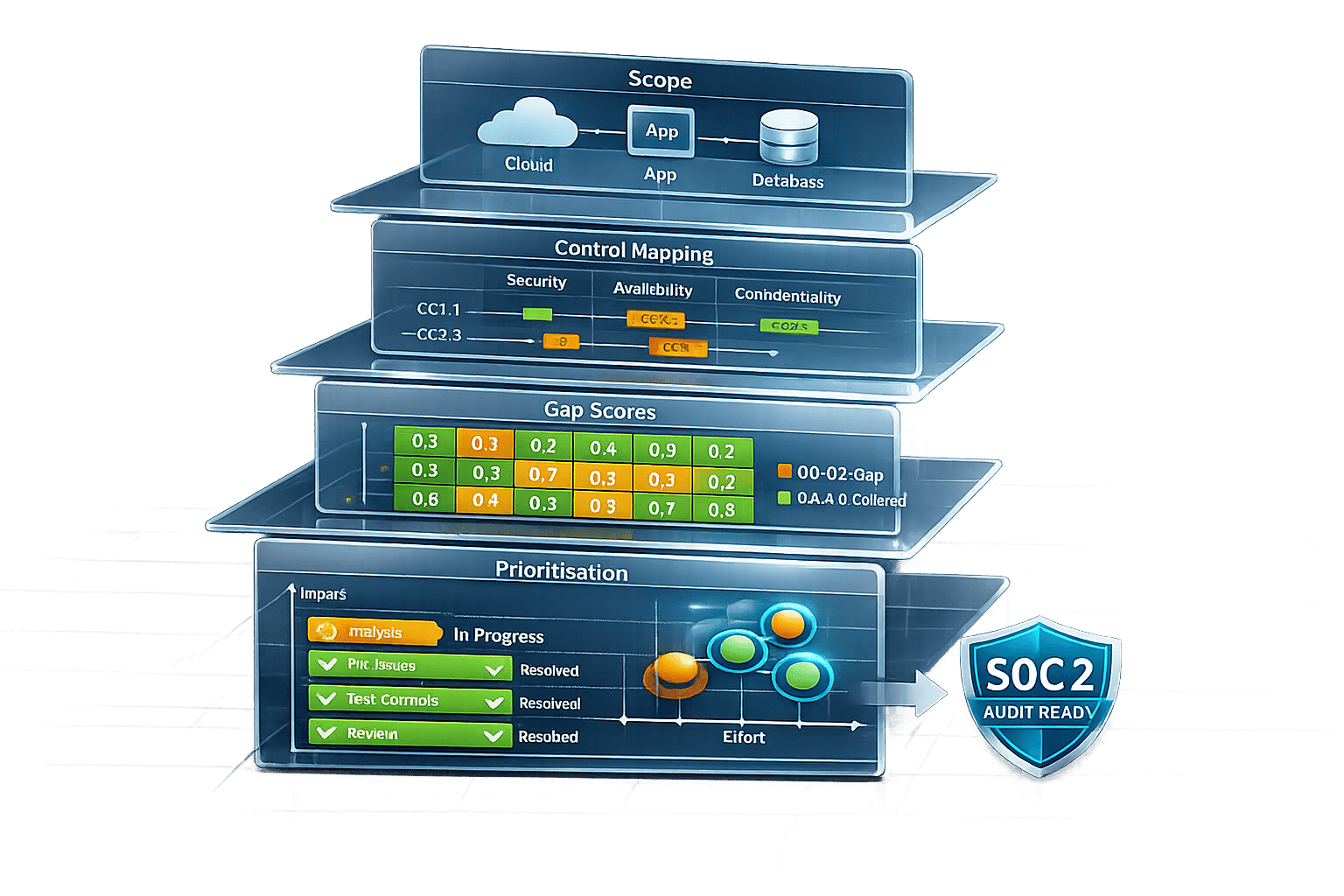
SOC 2 Gap Analysis: What It Is, How to Run One, and What to Fix First
SOC 2 gap analysis is the first step to ensure your organisation is ready for a SOC 2 audit. It identifies weaknesses in your current controls by comparing them against the AICPA's Trust Services Criteria (TSC). Without this step, you risk costly mid-audit surprises, extended timelines, and failed compliance efforts.
What It Does
Finds missing, undocumented, or unsupported controls in your system.
Why It Matters
Avoids last-minute fixes during the audit and demonstrates maturity to auditors.
Typical Costs
Readiness assessments range from ₹2–8 lakh; audits cost ₹3–10 lakh.
Common issues found during gap analysis include:
- Missing controls (e.g., no MFA, no logging)
- Lack of documentation for existing practices
- No evidence trail for implemented controls
Define the audit scope
Mandatory: Security; optional: Availability, Privacy, etc.
Assemble a cross-functional team
Security, engineering, HR, legal, and executive stakeholders.
Map current controls to SOC 2 requirements
Identify gaps and prioritise fixes
MFA, logging, vendor risk management, and more.
Build a remediation roadmap and validate readiness
SOC 2 compliance is crucial for Indian IT/ITeS, SaaS, fintech, and BPO firms to secure enterprise clients. A gap analysis ensures you're audit-ready, saving time, money, and effort in the long run.
What is SOC 2?Preparing for a SOC 2 Gap Analysis
To ensure a smooth and effective SOC 2 gap analysis, laying the groundwork is essential. Skipping the basics, like defining the scope or assembling the right team, can lead to incomplete findings and costly surprises during the audit.
Defining the Scope of Your Gap Analysis
A well-defined scope is the cornerstone of a successful SOC 2 gap analysis. Without it, you risk delays, cost overruns, and unnecessary complications during the audit process.
Start by selecting the Trust Services Criteria (TSC). The Security criterion is mandatory and includes 33 specific criteria across CC1 through CC9. Additional criteria — like Availability, Confidentiality, Processing Integrity, or Privacy — should only be included if they are explicitly required by your customer contracts.
Including criteria that are not relevant to your service creates an unnecessary audit surface without corresponding value to customers.
Next, define your system boundary. This should include all relevant infrastructure, applications, teams, and third-party sub-processors. At the same time, exclude non-production environments and unrelated IT systems.
For Type 2 audits, establish the observation period start date as early as possible. Any control gaps need to be addressed before this window opens, or they will automatically become findings during the audit.
Building the Right Team for the Assessment
SOC 2 compliance is not just a task for the security team — it requires collaboration across multiple departments. A cross-functional team ensures every gap is addressed promptly and effectively.
| Stakeholder | Primary Role in Gap Analysis | Key Evidence They Own |
|---|---|---|
| CISO / Security Lead | Leads the assessment, defines risk methodology | Risk register, incident response plan, vulnerability reports |
| Engineering / DevOps (CTO) | Implements technical controls, manages change management | Change tickets, pull request reviews, CI/CD test evidence |
| IT Operations | Manages access controls, MFA, and logging | IAM configs, system logs, access provisioning records |
| HR Team | Handles personnel security and training | Training completion logs, background check records, offboarding checklists |
| Legal / Procurement | Manages vendor risk and data agreements | Signed DPAs, vendor SOC reports, third-party risk assessments |
| Executive Team | Provides governance and tone at the top | Signed policies, management review meeting minutes |
One key principle to follow: assign every identified gap to a specific individual. Gaps assigned to a team often fall through the cracks. Use tools like Jira or ServiceNow to log and track gaps, as auditors expect detailed, time-stamped records rather than informal communications.
Manual vs Automated Gap Analysis: Choosing Your Approach
For smaller, Type 1 audits, spreadsheets may suffice, but they can be slow and prone to errors. Automated platforms are better suited for Type 2 audits, which require continuous compliance monitoring over a 6–12 month period.
AI-powered GRC platforms like CISOGenie automate evidence collection, policy management, and control mapping across multiple frameworks. For businesses in India dealing with overlapping obligations — such as SOC 2, ISO 27001, and RBI guidelines — these platforms help streamline compliance by reusing controls across frameworks.
The hardest part of passing your first SOC 2 audit isn't adding more controls — it's removing the ones you can't operate reliably.
How to Conduct a SOC 2 Gap Analysis: A Step-by-Step Guide
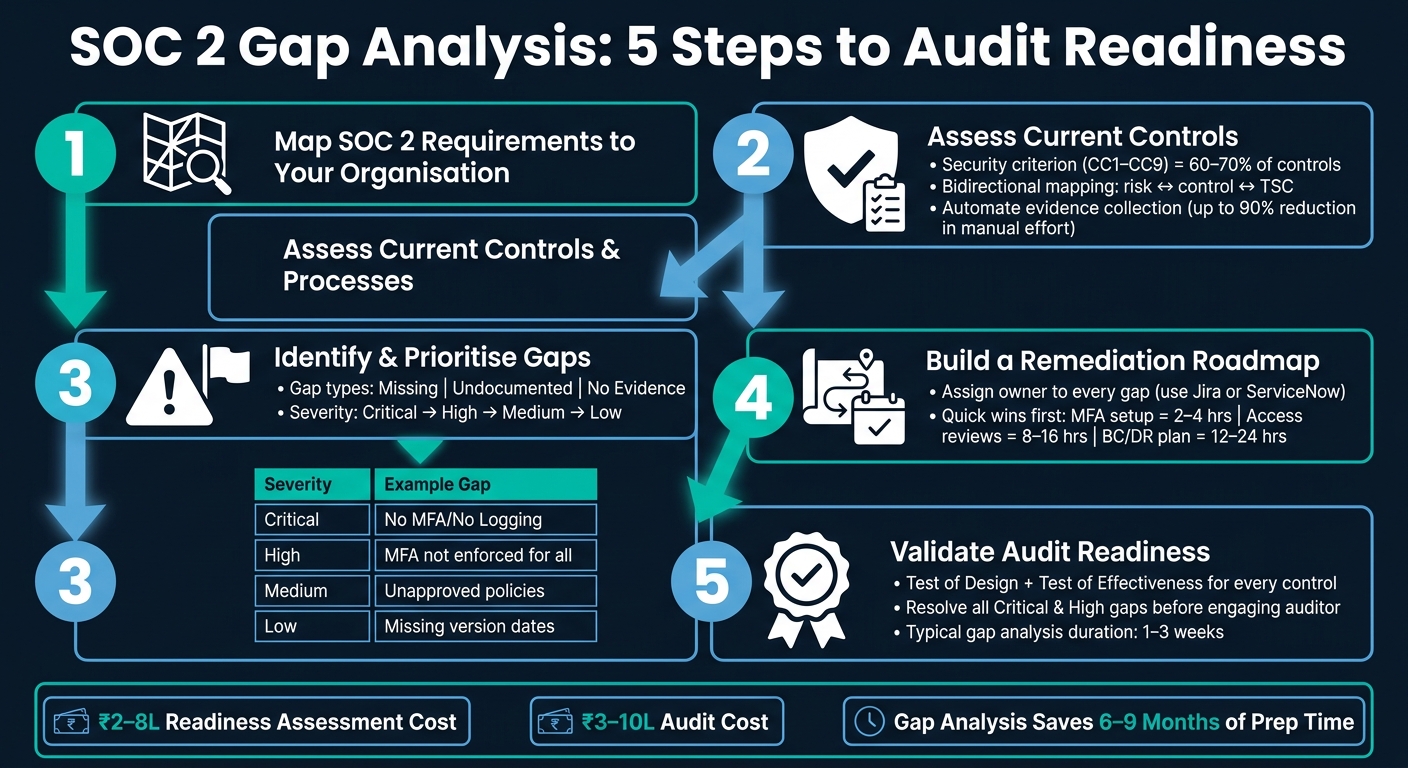
Once you've defined your scope and assembled your team, it's time to dive into the gap analysis process. These five steps provide a clear path to help you move from preparation to being audit-ready.
Step 1: Map SOC 2 Requirements to Your Organisation
Start by aligning the Trust Services Criteria (TSC) with your organisation's operations. The Security criterion (CC1–CC9) is mandatory and accounts for 60–70% of the SOC 2 control requirements. For many Indian SaaS and tech companies, this criterion often covers most compliance needs.
Use a bidirectional mapping approach. This ensures every identified risk corresponds to a specific control, and every control meets a TSC requirement. Avoid aspirational controls — those that look good on paper but serve no real purpose in practice.
Conduct walkthroughs with key team members like your CTO, Engineering leads, and HR team to understand the actual processes in place versus what policies state. Use these sessions as evidence probes to consider what an auditor would realistically find.
Step 2: Assess Your Current Controls and Processes
Most organisations already have controls in place, but the challenge lies in ensuring they are documented and leave an auditable trail.
| Control Domain | Typical Evidence Sources |
|---|---|
| Access Management | SSO logs, MFA reports, HR onboarding/offboarding tickets |
| Change Management | Git pull request history, CI/CD logs, Jira change tickets |
| System Operations | SIEM alerts, incident reports, backup restoration logs |
| Vendor Risk | Vendor SOC 2 reports, risk assessments, contracts |
Instead of manually gathering screenshots, automate evidence collection using tools like your IdP, Git repositories, or monitoring systems. Platforms like CISOGenie can cut manual evidence collection by up to 90%, which is especially helpful when juggling multiple frameworks like SOC 2, ISO 27001, and RBI guidelines.
Step 3: Identify and Prioritise Gaps
Classify gaps into three categories: Missing (no control exists), Undocumented (practices exist but lack documentation), or No Evidence (controls exist but leave no audit trail).
| Gap Severity | Definition | Audit Risk | Examples |
|---|---|---|---|
| Critical | No control for a core requirement | High | No MFA, no logging, no access reviews |
| High | Weaknesses in existing controls | Moderate-High | MFA enabled but not enforced for all users |
| Medium | Minor deficiencies in controls | Moderate | Policies not formally approved |
| Low | Documentation gaps only | Low | Missing version dates, incomplete vendor inventory |
Critical gaps — like missing MFA or logging — must be addressed before engaging an auditor, as they are almost guaranteed to result in exceptions.
Step 4: Build a Remediation Roadmap
Assign an owner to each gap. Use a severity-versus-effort matrix to prioritise tasks. Address critical gaps that require minimal effort first. For example, enabling MFA in your identity provider might take just a few hours but eliminates a major audit risk.
Hold brief weekly standups to track progress, resolve blockers, and adjust timelines. Document remediation evidence as you go — waiting until later can lead to missed details. For Type 2 audits, any unresolved gaps during the observation period will be flagged.
SOC 2 doesn't prove you're perfect — it proves you're reliable.
Step 5: Validate Audit Readiness
Before bringing in a CPA auditor, conduct an internal validation to ensure you're genuinely ready. Perform two checks for every control: a Test of Design (does the control address the intended risk?) and a Test of Effectiveness (is the control consistently working, with evidence?).
Treat every control as a hypothesis: 'If we claim X, an auditor should be able to see X happening repeatedly over time in system-of-record evidence.'
Engage your auditor only after resolving all critical and high gaps, along with most medium ones. A thorough gap analysis typically takes one to three weeks, depending on your organisation's complexity.
Prioritising SOC 2 Gaps: Where to Start
After identifying gaps in your SOC 2 compliance, the next step is figuring out how to tackle them. Not all gaps are created equal, so it's important to address the critical ones first.
High-Impact Technical Gaps to Address First
First-time SOC 2 audits often uncover issues like missing MFA enforcement, incomplete access reviews, lack of centralised logging, undocumented risk assessments, and absent incident response plans. MFA enforcement is a quick win — it typically takes just 2–4 hours to implement.
Centralised logging is another common area needing attention. Many organisations have partial logging coverage, but without proper alerting or sufficient retention periods, these gaps are flagged as high-severity. Establishing a centralised logging system that meets monitoring standards usually takes 4–12 hours.
A security program without a functioning risk assessment process is a collection of controls without a rationale.
For SaaS companies, Business Continuity and Disaster Recovery (BC/DR) planning often gets overlooked. SOC 2 requires companies to document and test their own backup and recovery processes. Creating and testing a Business Continuity Plan typically takes 12–24 hours.
Governance and Policy Gaps
Policies need to be actionable, not just written documents. Structural elements like risk assessments (CC3) and control activities (CC5) must be in place before an audit can proceed. Documenting a formal Risk Assessment can take anywhere from 8 to 20 hours.
Consider using a unified control set — one comprehensive policy per domain that aligns with multiple frameworks like SOC 2 and ISO 27001. For Indian SaaS companies, there's an estimated 80% overlap between these two standards.
Vendor and Third-Party Risk Gaps
Vendor risk management is a frequent issue in SOC 2 audits. Start by categorising vendors based on their criticality, especially those handling in-scope customer data. Formalise pre-onboarding assessments and ensure all supplier agreements include clear security clauses and Data Processing Agreements (DPAs).
Many organisations have a list of vendors but lack a documented assessment process, evidence that assessments have been conducted, and contractual information security requirements in supplier agreements.
Addressing vendor risk gaps generally takes 10–30 hours. Tools like CISOGenie use AI to analyse vendor contracts, extract security obligations, and quickly highlight any gaps.
Vendor ManagementMoving from Gap Analysis to Continuous SOC 2 Compliance
A gap analysis is just the beginning. The real challenge lies in ensuring that the issues you address today don't quietly resurface six months down the line. Transitioning from a one-time assessment to a continuous compliance model is where many organisations falter.
Setting Up Continuous Compliance Monitoring
Controls can fail unexpectedly — an engineer disables MFA for testing and forgets to re-enable it, a cloud storage bucket is misconfigured, or a vendor's security posture deteriorates. Without continuous monitoring, these issues can go unnoticed until the next audit cycle.
Continuous Control Monitoring (CCM) automatically scans your systems against SOC 2 requirements in real time. Organisations using automated and centralised audit workflows report cutting evidence collection time by up to 60%. Continuous monitoring allows compliance teams to focus on managing risks year-round.
Using AI to Improve Compliance Efficiency
AI-powered platforms interpret and contextualise compliance data. When a control deviates from its expected state, these platforms flag the issue, assess its severity, and recommend next steps. Automation tools can reduce the time spent on compliance activities by as much as 45%. CISOGenie uses AI agents to handle evidence gathering, policy mapping, and vendor contract analysis across over 35 frameworks.
What makes our hybrid approach so effective is that we've built technology that mirrors how auditors actually think and evaluate controls. Our platform doesn't just identify gaps — it helps you understand them in context, prioritize them based on risk, and provide guidance to implement solutions.
Compliance Dashboards for Leadership Visibility
CISOs and GRC leaders frequently need to provide updates to boards, investors, or enterprise customers. Centralised compliance dashboards turn technical control data into actionable insights. Tools like CISOGenie's dashboards consolidate audit readiness, open gaps, vendor risks, and policy statuses into one view — and help organisations respond to customer security questionnaires without delay.
Conclusion: Key Takeaways for SOC 2 Gap Analysis
A SOC 2 gap analysis serves as a diagnostic tool to assess where your controls stand before an auditor steps in. The process revolves around five key steps: scoping, control mapping, gap identification, building a remediation roadmap, and validating audit readiness.
The teams that move through audits most efficiently aren't the ones with the most controls — they're the ones with the clearest evidence, the most organised documentation, and the least internal confusion.
Transitioning from a one-time gap analysis to continuous compliance creates long-term benefits. Tools like CISOGenie simplify this shift by automating evidence collection, linking controls to risks, and offering real-time insights for leadership. This approach can dramatically reduce manual preparation time — from 6–9 months to as little as 28 days. For Indian SaaS companies, where the first-year SOC 2 investment typically ranges between ₹35–70 lakh, such efficiency improvements directly impact both costs and time-to-market.
Why CISOGenie for SOC 2Frequently Asked Questions
Ready to run your SOC 2 gap analysis?
See how CISOGenie maps controls, identifies gaps, automates evidence collection, and helps you prioritise fixes before your SOC 2 audit.