Third-Party Risk Assessment Questionnaire: Questions Every Security Team Should Ask Vendors
Ask clear questions, collect proof, score risk, and keep the file current — turn the questionnaire from a form into a decision gate.
Third-Party Risk Assessment Questionnaire: Questions Every Security Team Should Ask Vendors
If a vendor gets breached, you should already know your exposure. That is the job of a third-party risk assessment questionnaire: to help me decide whether to approve, approve with conditions, or reject a vendor before access is given or a contract is renewed.
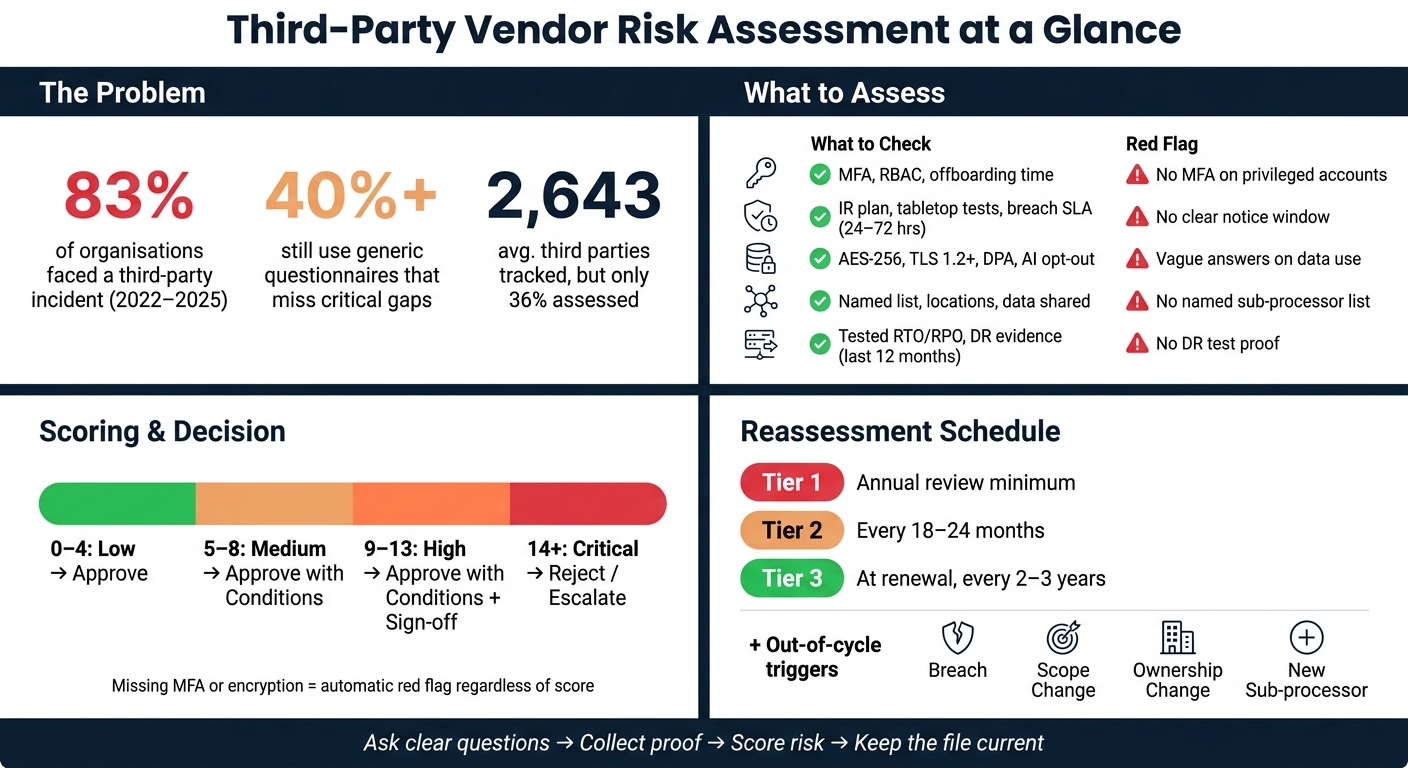
Here's the short version. The article shows that 83% of organisations faced at least one third-party incident between 2022 and 2025, while 40%+ still use generic questionnaires that miss key gaps. So the fix is simple: I need to ask for proof in the areas that matter most, score the answers in a consistent way, and review vendors again on a set schedule or after trigger events.
If I want a questionnaire that does its job, I should cover:
- Access and identity
- Security checks and incident response
- Patch timelines
- EDR coverage
- Annual pen test
- IR plan, tabletop tests, and breach notice within 24 to 72 hours
- Data handling and privacy
- Encryption at rest, such as AES-256
- Encryption in transit, such as TLS 1.2+
- DPA status
- Cross-border data transfer basis
- AI model training use and opt-out
- Sub-processors and recovery
- Named sub-processor list
- Data locations
- Flow-down contract duties
- RTO, RPO, and DR test proof from the last 12 months
- Evidence, not claims
- SOC 2 Type II
- ISO 27001 certificate and SoA
- Pen test report
- BCP/DR records
- Sub-processor records
I should also reassess vendors by tier:
- Tier 1: annual review at minimum
- Tier 2: every 18–24 months
- Tier 3: at renewal, usually every 2–3 years
- Plus any trigger event, like a breach, scope change, ownership change, or new sub-processor
A simple way to think about the article is this: ask clear questions, collect proof, score risk, and keep the file current. That turns the questionnaire from a form into a decision gate and gives me an audit trail I can stand behind.
| Area | What I should check | What should worry me |
|---|---|---|
| Access | MFA, RBAC, offboarding time | No MFA on privileged accounts |
| Incident response | IR plan, tabletop tests, breach SLA | No clear notice window |
| Data | Encryption, DPA, transfer basis, AI use | Vague answers on data use |
| Sub-processors | Named list, locations, data shared | No named list |
| Recovery | Tested RTO/RPO, DR evidence | No DR test proof |
The rest of the article explains how to build that questionnaire, what proof to request, how to score answers, and how to keep vendor reviews current as risk changes.
Core Question Categories Every Security Team Should Include
Use one core questionnaire for every vendor. Then add extra modules for high-risk services, regulated data, or AI-driven workflows. That way, each category helps you judge a simple but important point: is this vendor safe to onboard, renew, or send for deeper review?
Access Control, Security Operations, and Incident Response
Start with the controls that tend to break first: access, monitoring, and response.
Access and identity are often where third-party incidents kick off. In one recent compromise, OAuth tokens from a third-party platform led to data exfiltration across as many as 700 organisations. When identity controls and support workflows are weak, third-party access can go sideways fast.
Check whether MFA is enforced for all remote and privileged access. Ask how onboarding, role changes, and offboarding work under RBAC. Also verify how privileged API access and OAuth tokens are controlled. These answers should help you sort vendors into clear buckets: approvable, approvable with conditions, or blocked.
After that, look at how fast the vendor can spot and contain an incident. Verify patch timelines for critical vulnerabilities, endpoint detection and response coverage, and whether the vendor runs an annual independent penetration test. For incident response, confirm that a formal IR plan exists, how often tabletop exercises are run, and what breach-notification window the vendor will commit to. Set that window clearly, usually 24 to 72 hours. Ask for the IR plan and the latest penetration test report as proof.
Data Handling, Privacy, and Regulatory Compliance
Next, check how the vendor handles your data in storage, transit, and cross-border processing.
Ask about encryption at rest and encryption in transit as separate items. For data at rest, what standard is used? Is it AES-256? For data in transit, what TLS version is enforced? Is it TLS 1.2 or higher? Also confirm whether a Data Processing Agreement is in place and what basis is used for cross-border transfers if data moves across jurisdictions.
If the vendor uses AI in the service, ask whether customer data is used to train or fine-tune models, and whether there is a verifiable opt-out. Then map the vendor against the frameworks and obligations that apply, such as:
Request the latest audit report or certification as evidence.
Subcontractors, Business Continuity, and Resilience
Finally, check who else can affect service delivery and how the vendor will recover if things go wrong.
The average organisation tracks 2,643 third parties but assesses only 36% of them. That gap matters. Ask for a named list of sub-processors and any third-party dependencies that could affect service delivery. Also confirm that security duties are passed down through contract terms and that you'll be told before a new sub-processor is added.
For resilience, ask for the vendor's RTO and RPO for your service, and when the disaster recovery plan was last tested. Require DR test evidence from the last 12 months. If there's no DR test evidence, that's a risk no matter what the contract says.
Sample Questions, Evidence Requests, and Scoring Criteria
Sample Questions to Send to Vendors
Ask questions you can check, not vague promises. The goal is simple: test the access, data, and resilience controls you've already set. These questions line up with access control, data handling, and resilience.
- Access control: "What is your maximum access revocation time for an offboarded employee or contractor?"
- Incident response: "What is your breach-notification SLA, who receives it, and how often do you run tabletop exercises?"
- Data handling: "Is customer data used to train or fine-tune any AI or ML models? If yes, what is the opt-out mechanism?"
- Subcontractors: "Provide a named list of sub-processors, the data they process, and their locations."
- Business continuity: "What are the tested RTO and RPO for this service, and when was the last DR test conducted? Treat only tested values as valid."
Once you've set the questions, ask for artefacts that back up each answer.
Evidence to Request and How to Validate It
Every critical control claim needs proof.
| Evidence Type | What to Validate | Red Flags |
|---|---|---|
| SOC 2 Type II | Report date, scope, and opinion | Outdated report (older than 12 months); scope excludes the service or region |
| ISO 27001 | Certificate validity date and Statement of Applicability (SoA) | Certificate expired; SoA excludes critical controls such as encryption or access management |
| Penetration Test | Date of test, independent third-party tester, and remediation status of "High" findings | Only a clean executive summary provided, with no evidence that critical vulnerabilities were fixed |
| BCP / DRP | Last test date and lessons learned | No test record or no RTO/RPO evidence |
| Sub-processor List | Named entities, data types shared, and processing locations | Vendor refuses to name sub-processors or lists only a vague "global" location |
Scope matters a lot here. A SOC 2 report that covers a vendor's corporate headquarters, but not the cloud environment hosting your data, is weak evidence. On paper, it may look fine. In practice, it tells you little about the system you'll rely on.
Use this evidence to sort low-risk vendors from conditional approvals and outright rejections.
How to Score Responses and Spot Red Flags
Score responses against the control areas above, not as isolated form answers. Use impact for tiering and likelihood for questionnaire scoring.
A weighted rubric works best. Give more weight to high-sensitivity areas like access control, incident response, and data handling than to lower-risk items. If a vendor is missing MFA on privileged accounts, that should be a hard red, no matter how polished the rest of the response looks. High-risk control failures should override otherwise strong answers. Over 40% of organisations still rely on generic questionnaires that miss exactly these kinds of critical gaps.
| Risk Score Band | Decision | Next Step |
|---|---|---|
| 0–4: Low | Approve | Standard evidence record; annual review |
| 5–8: Medium | Approve with Conditions | Close obvious gaps before broad deployment |
| 9–13: High | Approve with Conditions | Require security, privacy, and business sign-off; track remediation |
| 14+: Critical | Reject | Escalate to formal risk acceptance or block until gaps are closed |
Be careful with answers that sound polished but say almost nothing. Phrases like "we follow industry best practices" or "security is a top priority" without proof are red flags. The same goes for missing sub-processor detail. If a vendor cannot produce a named sub-processor list, you're looking at a fourth-party risk blind spot, and regulators are increasingly holding organisations accountable for their vendors' sub-processors.
How to Run Vendor Questionnaires as Part of a Continuous Compliance Programme
Moving from Manual Reviews to Continuous Vendor Risk Management
Once you've scored responses, the next job is to keep them current. A questionnaire only helps if the findings stay active as vendor risk shifts over time.
Use the reassessment cadence and trigger events already set for each vendor tier to start reviews and out-of-cycle checks.
Red-rated answers should trigger remediation right away, not sit around until the next review cycle. Red-rated findings should move into the corporate risk register and remediation tracker immediately. And set the next reassessment date in your vendor management tracker on the day the contract is signed, not when expiry is around the corner.
At portfolio scale, manual handling starts to break down. That's where automation comes in.
Using CISOGenie to Automate Questionnaire Workflows and Evidence Mapping
Automation helps connect questionnaire review, evidence collection, and audit-ready reporting.
CISOGenie is an AI-driven GRC platform built to keep vendor risk evidence current and mapped. Its AI workflows handle first-pass scoring against internal control criteria, then flag gaps for human review instead of forcing reviewers to grade responses by gut feel. Evidence is collected and validated automatically through vendor Trust Centre integrations.
Vendor responses map directly to framework controls across ISO 27001, SOC 2, GDPR, and DPDPA. So each completed assessment adds to audit-ready evidence, instead of ending up in a disconnected spreadsheet.
For Tier 1 vendors, continuous monitoring tracks breach notifications, sub-processor changes, and material ownership changes between formal assessment cycles. That gives teams a vendor risk programme built around the same decision path used across the rest of this process:
- ask the right questions
- score the answers
- act on the risk
- keep evidence current through questionnaire refresh, evidence mapping, and vendor monitoring
Conclusion: Questions That Improve Vendor Decisions and Audit Readiness
Once your questions, evidence, and scoring are set, the questionnaire stops being a box-ticking exercise. It becomes a decision gate. A third-party risk assessment questionnaire matters only when it leads to a clear call: approve, approve with conditions, or reject. The aim is simple: make a defensible, evidence-backed decision before access is granted or a contract is renewed.
Audit-ready programmes depend on proof you can verify, such as SOC 2 Type II reports, penetration test summaries, and DPAs - not unchecked claims. Segment vendors before sending the questionnaire. Ask for artefacts, not promises. Use the same scoring rubric across areas like information security and data privacy. And treat critical-fail items, such as missing MFA or encryption, as non-negotiable.
Continuously evaluate third-party risk as a process, not a one-time review. Keep questionnaire findings in the risk register, map evidence to framework controls, and reassess vendors on a tiered cadence and after trigger events like breaches, scope changes, or sub-processor updates. That is what turns vendor questionnaires into a continuous compliance control.
Frequently Asked Questions
Frequently Asked Questions
Ready to Automate Vendor Risk Questionnaires End to End?
See how CISOGenie scores vendor responses, maps evidence to framework controls, and keeps third-party risk current between assessment cycles.