What is an Agentic GRC Platform?
How autonomous AI agents are replacing manual compliance workflows — and what it means for CISOs, MSSPs, and security teams who are done with compliance theatre in 2026.
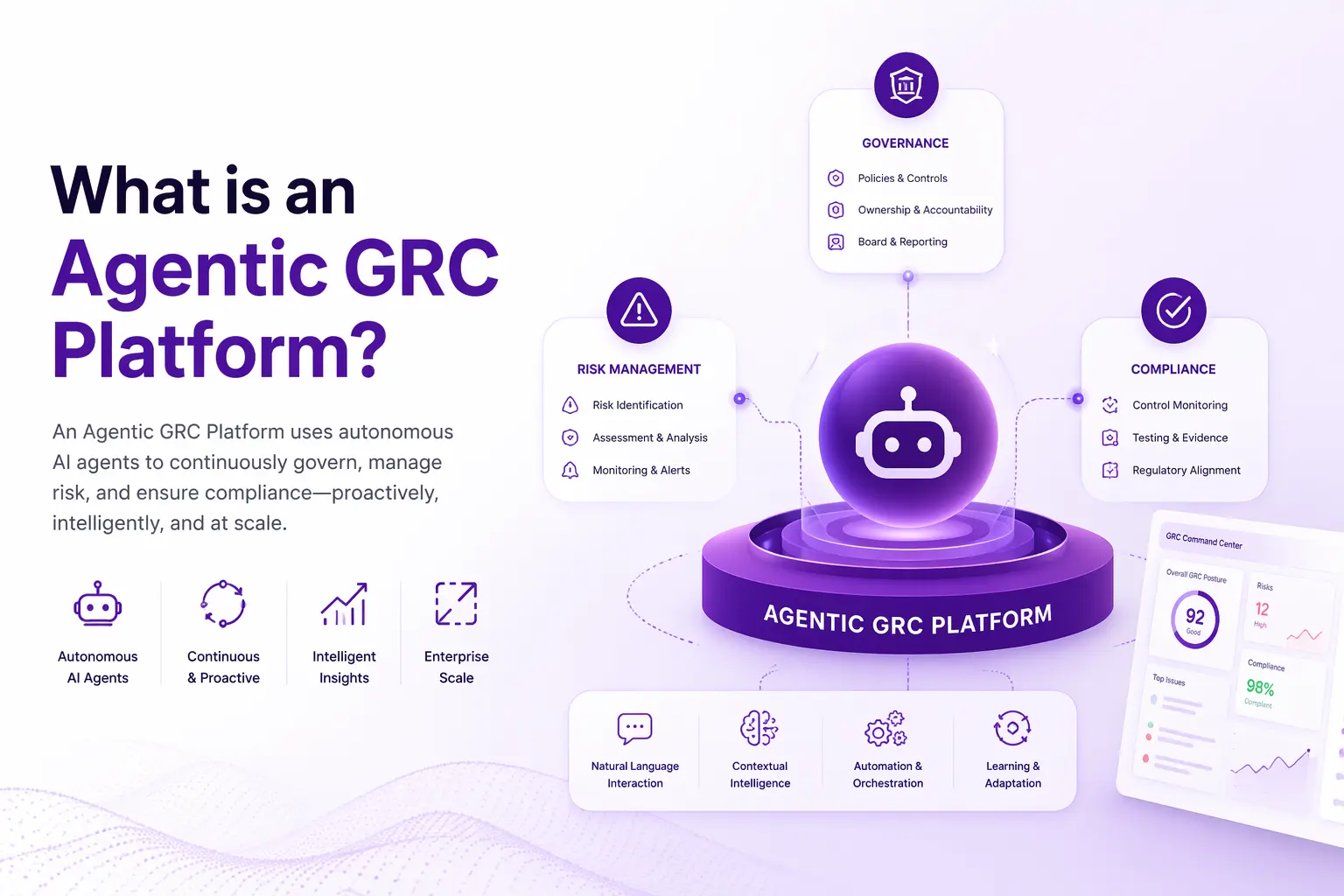
If you've spent any time managing GRC in a real enterprise environment, you already know the dirty secret: most GRC programmes are essentially manual compliance theatre. Auditors ask for evidence, someone scrambles to pull screenshots, an analyst spends three weeks buried in spreadsheets, a report gets produced — and the cycle repeats without actually reducing risk. Nobody sleeps better. Nothing gets safer.
Something had to change. And in 2025–2026, it did.
The agentic GRC platform is the next generation of governance, risk, and compliance management — one where AI agents do the heavy lifting autonomously, continuously, and at scale. It's not "GRC with a chatbot bolted on." It's a fundamentally different operating model, built on a risk-led security platform management philosophy: that your GRC programme should be driven by real, live risk intelligence — not by what's convenient to collect manually once a quarter.
At CISOGenie, we've built our entire platform around this principle. In this article, we'll break down exactly what an agentic GRC platform is, why it represents a category-defining shift, and how forward-looking security teams are using autonomous GRC to run leaner, faster, and far more defensible compliance programmes.
Explore CISOGenie AI Agents1. The Problem with Traditional GRC (And Why It's Getting Worse)
Traditional GRC platforms were designed for a world where compliance was a periodic event — an annual audit, a quarterly risk review, a yearly vendor assessment. They gave organisations a place to store policies, track tasks, and generate reports. Honestly, for a simpler time, that was fine.
But security in 2026 doesn't work that way. Threats are continuous. Regulations are multiplying — DORA, NIS2, SEBI CSCRF, India's DPDP Act, and a dozen others are all demanding real-time posture visibility. And the number of third-party vendors in the average enterprise ecosystem has grown to the point where manual third-party risk management is simply impossible to do well.
The result? GRC teams are drowning. And the platforms meant to help them are making things worse:
- Evidence collection is manual and soul-crushing. Someone has to log in to 40 different tools, download screenshots, rename files, and upload them to a portal — every single quarter. This is where compliance management programmes go to die.
- Risk scoring is subjective and stale. Most risk registers are updated once or twice a year, making them a historical record rather than a live picture of risk. That's not risk management — it's risk archaeology.
- Vendor risk is assessed by questionnaire. A 200-question Excel spreadsheet sent to a vendor — who fills it out manually, weeks later — tells you almost nothing about their actual security posture. It's trust, not verification — which is why vendor management needs to go beyond spreadsheets.
- Reporting is backward-looking. By the time a risk report reaches the board, the data it's based on is months old. The conversation you're having is about a company that no longer exists.
2. What Does "Agentic" Mean in AI — and Why It Matters for GRC?
The word "agentic" has a specific meaning in the AI context — and it's worth taking a moment to understand it properly before we apply it to compliance management, because people throw this term around loosely.
An AI agent is a software system that can perceive its environment, reason about a goal, plan a sequence of actions, execute those actions using tools (APIs, browsers, databases), and adapt based on what it observes — all without requiring a human to direct each step. Think of it less like a calculator and more like a very capable, tireless junior analyst who never needs a coffee break.
This is fundamentally different from a standard AI assistant, which responds to prompts but can't take sustained autonomous action. An AI agent in compliance can:
- Log into a third-party vendor portal and extract security configuration data without anyone lifting a finger
- Crawl your cloud environment to verify a control is actually deployed — not just documented in a policy nobody reads
- Cross-reference a new CVE against your asset inventory and automatically update affected risk items in real time
- Generate and submit a complete audit evidence package with zero human input, ahead of schedule
"Agentic AI doesn't just answer questions about your GRC programme. It runs your GRC programme — and it never calls in sick."
3. Defining the Agentic GRC Platform
So what is an agentic GRC platform, exactly? Here's a definition we've refined through building one:
An agentic GRC platform is a governance, risk, and compliance operating model in which autonomous AI agents continuously collect evidence, assess risk, monitor controls, and surface findings — replacing manual human workflows across the entire compliance lifecycle. It's the practical embodiment of risk-led security platform management: letting real-time risk intelligence drive your programme, not calendar events.
The key word is continuously. Not quarterly. Not annually. Always. This is what separates genuine autonomous GRC from the wave of "AI-enhanced" GRC tools that are essentially legacy platforms with a natural language search box added.
A true agentic GRC platform — like CISOGenie — doesn't wait for an auditor to ask for evidence. It has already collected it: from every tool in your stack, every vendor in your ecosystem, and every configuration across your cloud environment. When the auditor asks, the answer is already there, timestamped, and linked to the relevant framework control.
4. The 4 Pillars of an Agentic GRC Platform
Agentic GRC isn't a single feature — it's a set of interconnected capabilities that, together, replace the manual workflows that have made traditional compliance management so painful for security teams. Here are the four pillars that define a real agentic GRC platform, and how CISOGenie implements each one — including multi-framework compliance monitoring at scale.
Automated Evidence Collection
CISOGenie's AI agents autonomously connect to your tools — cloud platforms, SaaS applications, security scanners, vendor portals — and pull evidence without human involvement. Your credentials stay with you. The agent uses them on your behalf, in real time, around the clock.
Continuous Control Monitoring
Risk registers are updated in real time as new findings emerge from simulations, CVE feeds, vendor assessments, and continuous control monitoring — not when someone finally remembers to update a spreadsheet. Your risk picture is always current.
Autonomous Third-Party Risk Management
Instead of waiting weeks for vendors to fill out questionnaires, CISOGenie's agents assess vendor security posture directly — querying APIs, reviewing published security documentation, and monitoring for changes on a continuous basis.
Multi-Framework Compliance at Scale
For MSSPs and MSPs managing multiple clients, CISOGenie's agentic GRC platform handles multi-framework compliance and multi-tenant operations simultaneously — running independent compliance programmes across all clients from a single pane of glass.
5. Agentic GRC vs. Traditional GRC: A Straight Comparison
The difference between traditional and agentic GRC isn't incremental — it's architectural. Here's a direct comparison across the dimensions that matter most to security teams. We built CISOGenie specifically to win on every one of these — including audit prep without the quarterly scramble.
| Capability | Traditional GRC | Agentic GRC (CISOGenie) |
|---|---|---|
| Evidence collection | Manual, periodic, human-driven | ✓Automated, continuous, agent-driven |
| Risk scoring | Quarterly or annual updates | ✓Real-time, triggered by control changes |
| Vendor risk assessment | Questionnaire-based, slow, unreliable | ✓Autonomous assessment via APIs & agents |
| Audit readiness | Scramble before every audit | ✓Always audit-ready; evidence pre-collected |
| Framework coverage | One framework per implementation | ✓Multi-framework simultaneously |
| Data sovereignty | Data stored on vendor's servers | ✓Data stored in your chosen location |
| MSSP / multi-tenant | Separate instances, siloed reporting | ✓Native multi-tenancy, unified dashboard |
| Scalability | Grows linearly with headcount | ✓Scales without additional GRC headcount |
6. MITRE ATT&CK Simulation and Qualitative Risk Analysis
One of the most compelling applications of an agentic GRC platform is integrating MITRE ATT&CK-based simulation results into your live risk programme — automatically, without an analyst spending a week mapping findings by hand.
Here's how it typically plays out without CISOGenie: your red team or BAS (Breach and Attack Simulation) tool runs a simulation mapped to MITRE ATT&CK tactics and techniques. That report lands in a PDF. It sits there for weeks — sometimes months — before anyone maps it to risk items, controls, or remediation tasks. By the time it reaches the risk register, it's already partially stale.
With CISOGenie's agentic GRC platform, the simulation results are ingested in real time. The platform's AI agents cross-reference each detected technique against your asset inventory and control framework, apply qualitative risk scoring (Likelihood × Impact on a 5×5 matrix), and populate your risk register automatically — with evidence attached and MITRE tactic tags for full traceability. No analyst handoff. No lag. No stale data.
The 14 MITRE ATT&CK tactics — from Reconnaissance through to Impact — each carry a different inherent risk profile. Persistence, Privilege Escalation, Lateral Movement, Credential Access, and Exfiltration consistently score Critical in enterprise environments. Discovery typically scores Medium. CISOGenie maps each simulation finding to the appropriate zone of the risk matrix — instantly, without analyst involvement — and feeds it directly into your continuous control monitoring workflow.
Risk Profiling Agent7. Why Agentic GRC Is Particularly Well-Suited for MSSPs
For Managed Security Service Providers, traditional GRC tools have always been a poor fit — and if you've tried to run a GRC practice on one, you already know exactly why. They were designed for single-tenant enterprise deployments, not for an MSSP managing compliance programmes across 20, 50, or 100 clients simultaneously. Every new client meant another instance, another spreadsheet, another silo.
CISOGenie's agentic GRC platform changes the economics of running a GRC practice entirely — through a combination of autonomous GRC operations and native multi-tenancy:
- One platform, all clients. Native multi-tenancy means each client's data is isolated, but your team manages everything from a single interface — with per-client dashboards, reporting, and risk registers. No more tab-switching or context-switching between tools.
- Scale without hiring. Because AI agents handle the automated evidence collection and initial risk scoring, an MSSP can take on more clients without proportionally growing the GRC headcount. That's a fundamentally different unit economics model.
- Differentiated service delivery. When your evidence is automated and your risk register is always current, you can offer clients monthly risk reporting instead of quarterly. In a competitive MSSP market, that's a meaningful differentiator.
- Standardised methodology. CISOGenie's agents apply consistent risk scoring methodology across all clients, eliminating the inconsistency that naturally creeps in when different analysts use different approaches. One standard. Every client. Every time.
8. How CISOGenie Implements Agentic GRC — and Why It's Different
CISOGenie is an AI-powered GRC platform built specifically for CISOs, MSSPs, MSPs, and security consultants. It was designed from the ground up — not retrofitted from a legacy GRC tool that predates modern cloud infrastructure — to support fully autonomous GRC operations at any scale.
Our approach is grounded in a single conviction: GRC should be driven by real, continuous risk intelligence, not by what's convenient to collect manually. That's what we mean by Risk-Led Security Platform Management — and it's what makes CISOGenie fundamentally different from every other platform in this space.
Key implementation principles that make CISOGenie different:
- Data sovereignty by design. CISOGenie agents collect evidence on your behalf, but that evidence is stored in a location you control — not on CISOGenie's servers. Your credentials never leave your environment. This isn't a feature we added — it's how we built the architecture from day one.
- MCP and API-first architecture. AI agents connect to your existing tools via Model Context Protocol (MCP) and native APIs — covering cloud platforms, SaaS applications, security scanners, and vendor portals without requiring agents to be installed in your environment. Your stack stays clean.
- Framework-agnostic audit management. Whether you're managing ISO 27001, SOC 2, NIST CSF, DORA, or India's DPDP Act, CISOGenie maps evidence and risk findings to the relevant framework controls simultaneously, in the same platform. This is true multi-framework compliance — not a checkbox labelling exercise.
- Browser agents for complex evidence. Where no API exists, CISOGenie's browser agents can navigate vendor portals, configuration consoles, and admin interfaces to extract evidence — exactly as a human analyst would, but faster and at 3am if needed.
The CISOGenie Approach: Risk-Led Security Platform Management
Most GRC platforms were built by software companies who hired compliance consultants to tell them what to build. CISOGenie was built the other way around — by security practitioners who got tired of the tools available to them and decided to build something better.
The philosophy behind CISOGenie's agentic GRC platform is what we call Risk-Led Security Platform Management: the idea that your entire security programme — not just your compliance function — should be anchored to a continuously updated, evidence-backed view of actual risk. Not risk as it appeared at last quarter's review. Risk as it exists right now, in your environment, given your current control posture and your current threat exposure.
In practice, this means:
- Compliance management follows risk, rather than driving it. You don't chase certifications — you maintain a security posture that certifications recognise.
- Audit management becomes a byproduct, not a project. Because CISOGenie collects evidence continuously, audit readiness is a permanent state — not a three-week scramble.
- Third-party risk management is ongoing, not periodic. Vendor posture changes daily; your assessment of it should too.
- AI agents in compliance act as the connective tissue — pulling data, scoring risk, flagging changes, and keeping every stakeholder informed without creating work for your team.
This is what separates CISOGenie from a tool that claims to do "AI-powered GRC" while still fundamentally relying on humans to interpret, update, and maintain the programme. Autonomous GRC isn't a feature — it's an operating model. And it's the only model that scales with the reality of modern security. See how teams get audit-ready in 28 days and what CISOGenie automates vs. what your team still owns.
Frequently Asked Questions
Ready to see CISOGenie's Agentic GRC Platform in action?
CISOGenie completes gap assessments up to 3× faster than traditional methods. See how automated evidence collection, continuous control monitoring, and AI-driven risk scoring can transform your compliance programme — and what Risk-Led Security Platform Management actually looks like in practice.