ISO 27001 Checklist: What to Assess Before Certification
A practical checklist for scoping your ISMS, running gap analysis, mapping risks to Annex A controls, and gathering audit-ready evidence before certification.
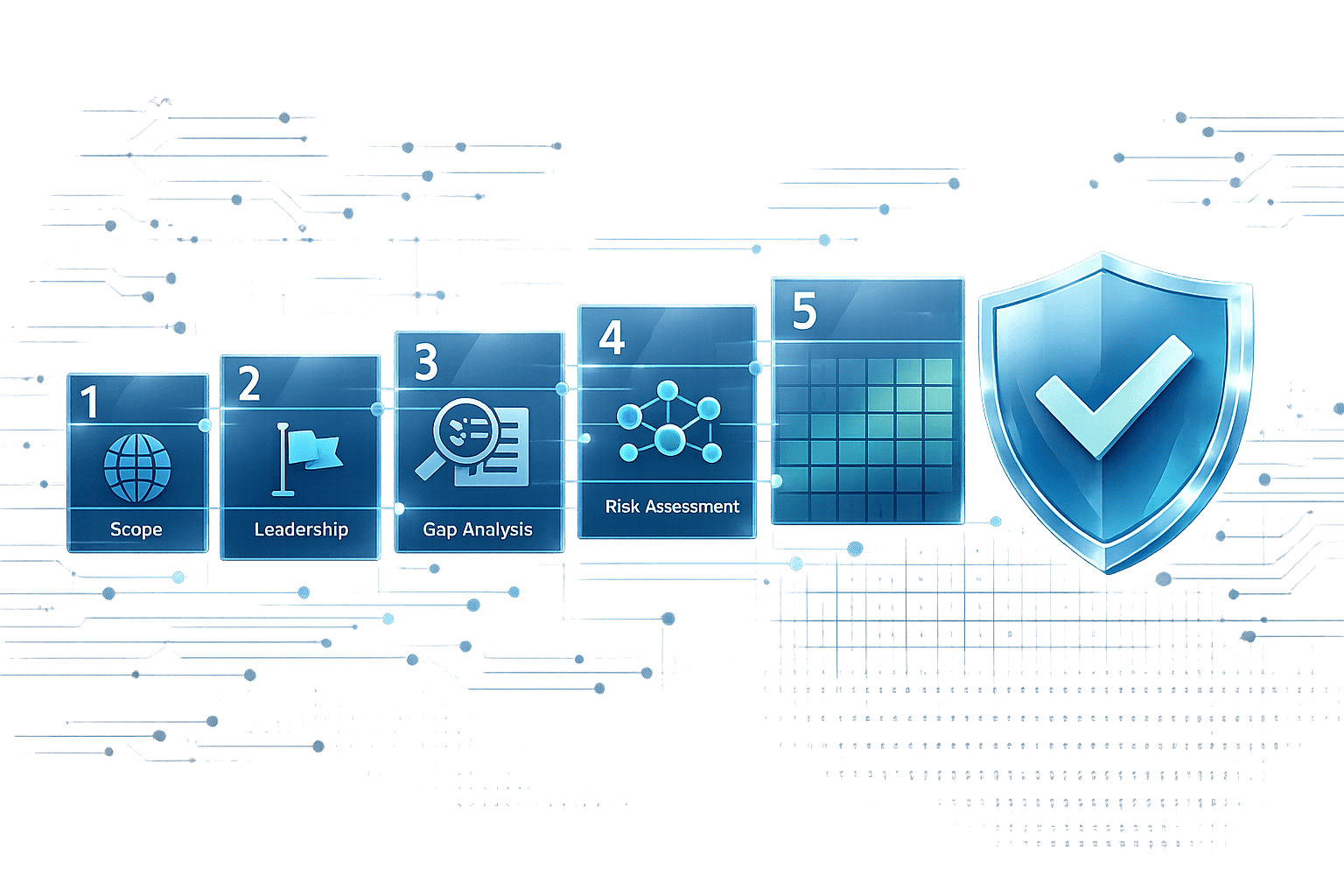
ISO 27001 Checklist: What to Assess Before Certification
ISO 27001:2022 certification ensures that your organisation's Information Security Management System (ISMS) meets global standards. It focuses on protecting sensitive information's confidentiality, integrity, and availability. To achieve certification, you must address both Clauses 4–10 (management requirements) and Annex A (93 controls across organisational, people, physical, and technological categories). However, certification isn't about implementing controls alone — documenting your risk assessment and aligning with leadership is equally critical.
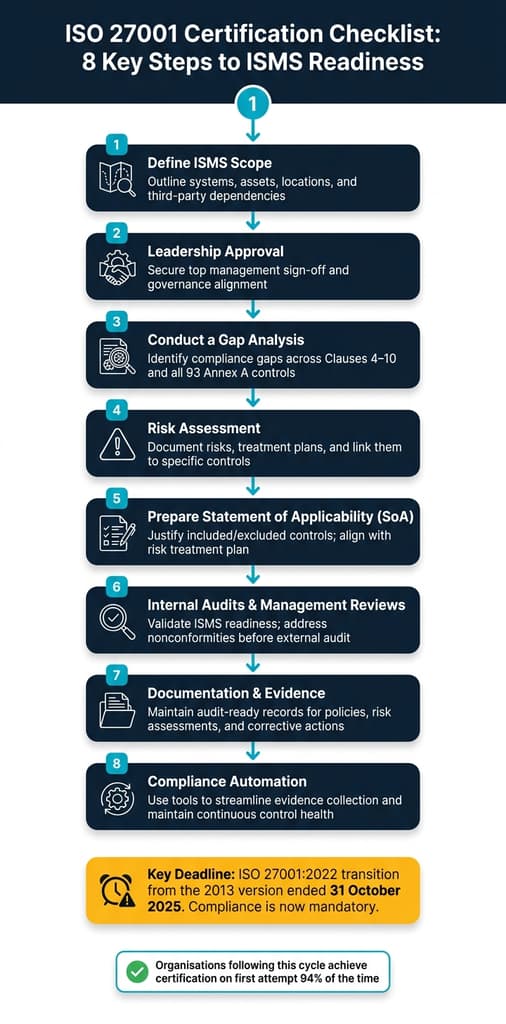
Define ISMS Scope
Clearly outline systems, assets, locations, and third-party dependencies. Avoid overly broad or narrow scopes.
Leadership Approval
Secure top management's sign-off on the scope and ensure governance alignment.
Conduct a Gap Analysis
Identify compliance gaps across Clauses 4–10 and Annex A controls using a structured gap assessment.Risk Assessment
Document risks, treatment plans, and link them to specific controls in your risk register.Prepare the Statement of Applicability (SoA)
Justify included/excluded controls and ensure alignment with your risk treatment plan.
Internal Audits & Management Reviews
Validate ISMS readiness and address nonconformities before external audits with audit management workflows.Documentation & Evidence
Maintain audit-ready records for policies, risk assessments, internal audits, and corrective actions through automated evidence collection.Compliance Automation
Use CISOGenie to streamline evidence collection and maintain control health continuously.
Key deadline: Organisations must comply with ISO 27001:2022 — the transition from the 2013 version ended on 31 October 2025. Compliance is increasingly tied to local regulations like India's DPDP Act.
This checklist simplifies your path to certification by focusing on scope clarity, leadership alignment, risk management, and audit readiness.
Defining the Scope and Boundaries of Your ISMS
Nailing down the scope of your ISMS is arguably the most crucial step in your ISO 27001 journey. If the scope is too broad, you'll struggle to provide the evidence needed to meet compliance. On the other hand, a scope that's too narrow might leave key systems unprotected, raising concerns during the Stage 1 audit.
Scope-setting is the most common first-cycle failure: SMEs declare an over-broad scope to look impressive, then cannot evidence the scope they declared.
Setting the ISMS Context
Clause 4 of ISO 27001:2022 requires organisations to define their internal and external contexts before moving forward. This means documenting regulatory requirements like India's DPDP Act, RBI guidelines, and CERT-In directives, alongside factors such as your competitive environment, organisational culture, and technical infrastructure.
Additionally, the February 2024 amendment (Amd 1:2024) has introduced a new requirement under Clause 4.1: organisations must now assess climate change as part of their ISMS context. Another critical aspect is mapping your interested parties — customers, regulators, employees, and partners — since their expectations will directly influence the scope of your ISMS.
Identifying Systems, Assets, and Locations in Scope
Once the context is clear, inventory everything that handles sensitive information. This includes cloud platforms, SaaS tools, internal databases, development environments, physical offices, data centres, and remote work setups. You'll also need to map third-party dependencies such as cloud providers, managed service providers (MSPs), and key vendors, classifying them based on risk.
| Scope Component | What to Include | Evidence to Prepare |
|---|---|---|
| Systems | Cloud platforms, SaaS tools, internal databases, dev tools | Architecture diagrams, CMDB exports |
| Assets | Customer data, source code, IP, hardware | Asset register, data classification records |
| Locations | Physical offices, remote work setups, data centres | Site maps, access logs, remote work policies |
| Third Parties | Cloud providers, MSPs, critical vendors | Supplier list, risk classifications, NDAs |
For cloud-native B2B SaaS companies, include your corporate identity provider and office network if they interact with customer data. If certain controls are inherited from cloud providers, explicitly document this as "inheritance" rather than excluding them entirely. Once your assets and systems are mapped, you'll need top management to formally approve the scope to move forward.
Leadership Buy-In and Governance Alignment
The scope document is a cornerstone of your ISMS and appears on your ISO 27001 certificate. It must be signed off by top management to pass auditor scrutiny. During certification, auditors will often interview executives to evaluate the "tone at the top." Any disconnect between leadership's statements and the ISMS documentation can result in non-conformance.
Policies drafted solely by security teams and left unsigned by leadership are considered unofficial by auditors. Clause 5.3 also emphasises assigning clear ownership for each ISMS domain — HR for people controls, IT for technical controls — so evidence collection doesn't become the responsibility of a single person. Use policy lifecycle management to maintain signed, version-controlled policies.
Finally, secure a board resolution or signed management directive that outlines the agreed scope, risk appetite, and resource allocation before moving forward with the gap analysis phase.
Running a Gap Analysis Against ISO 27001 Requirements
Once you've defined your ISMS scope and secured leadership alignment, assess how your current security measures stack up against ISO 27001:2022 requirements. A gap analysis helps identify shortcomings before implementation begins. Skipping this step can lead to a 40% increase in execution time as issues are often discovered during auditing.
Assessing Compliance at the Clause Level
Clauses 4 through 10 are the foundation of ISO 27001, outlining the structure of your management system. To assess compliance, evaluate each clause in detail:
- Document your risk assessment method (Clause 6).
- Schedule internal audits as per Clause 9.2.
- Record management reviews in line with Clause 9.3.
The certificate is for the ISMS, not for the controls. You can implement all 93 Annex A controls and still fail certification if your risk assessment is not documented or your leadership review does not happen.
It's not enough to rely on verbal confirmations. You need signed procedures, audit logs, and documented outputs to prove compliance. Ensure that every control is backed by concrete, audit-ready evidence.
Checking Readiness Across Annex A Controls
The 2022 update reorganised Annex A into four themes: Organisational, People, Physical, and Technological. It streamlined the total from 114 to 93 controls and introduced 11 new controls focusing on threat intelligence, cloud security, and data leakage prevention.
- Access control (A.5.15)
- Vulnerability management (A.8.8)
- Configuration management (A.8.9)
Go through all 93 controls to determine their status: fully implemented, partially implemented, or not implemented. For cloud-native setups, identify which controls are inherited from providers and document these in your Statement of Applicability (SoA) to avoid gaps during the audit.
Building a Readiness Matrix
| Column | Purpose |
|---|---|
| Control / Clause | The specific ISO 27001 requirement or Annex A control |
| Current State | Compliance status: None, Partial, or Full |
| Gap Description | What is missing, weak, or undocumented |
| Priority | Risk-based urgency: Critical, High, Medium, or Low |
| Owner | Individual or department responsible for remediation |
| Target Date | Deadline for remediation |
This matrix serves as a roadmap for addressing gaps efficiently. Initial gap analyses in organisations that haven't been audited typically reveal compliance gaps ranging from 25% to 40%. Run yours through automated gap assessment to prioritise remediation faster.
Preparing Your Risk Assessment and Treatment Plan
Once your readiness matrix is in place, craft a solid risk assessment and treatment plan. Many organisations falter here — not because they fail to identify risks, but because they don't fully document the process of identifying them.
Documenting the Risk Assessment Process
Auditors want a well-documented, repeatable process that defines risk criteria, scoring methods, and clear definitions for likelihood and impact. Your risk register should include key details for each risk: its owner, a rating, and the assets it affects. The Risk Treatment Plan must outline specific actions — mitigate, accept, transfer, or avoid — with timelines and assigned responsibilities. Maintain this in a live risk management platform, not a static spreadsheet.
Risk assessment and treatment: Document all assets, threats, and vulnerabilities. Link each risk to treatment. This is Clause 6.1–6.2 evidence required by auditors.
Risk assessments need periodic updates, especially after major organisational changes. For Indian businesses, this is particularly important when regulatory shifts under the DPDP Act or RBI directives impact data handling requirements.
Validating the Statement of Applicability
The Statement of Applicability (SoA) lists all 93 Annex A controls and specifies whether each one applies to your organisation, with clear justifications for every inclusion or exclusion.
The SoA links Clauses and Annex A. It names every Annex A control, states whether you include it in scope, and justifies each inclusion or exclusion. The SoA is the single most-scrutinised document in a Stage 1 audit.
Avoid vague justifications like "not applicable to our business." Every exclusion must have a specific, business-relevant explanation. Your SoA must align with your latest Risk Treatment Plan — if a control addresses a specific risk, it must be marked as applicable.
Mapping Risks to Assets and Controls
| Mapping Component | Example |
|---|---|
| Asset | Customer database |
| Threat | Ransomware attack |
| Vulnerability | Outdated software patching |
| Annex A Control | A.8.8 (Vulnerability Management) & A.8.13 (Backup) |
| Evidence | Patch logs and successful restore test records |
Assign clear ownership for each control — HR for employee screening, Facilities for physical security, and so on. Gather at least 30 days of evidence for each mapped control to prove it's operational. Continuous monitoring helps maintain that evidence trail between audit cycles.
Getting Your Evidence, Documentation, and Audit Trail in Order
Maintaining well-organised documentation is critical for ensuring compliance without chaos. For an ISO 27001 ISMS, this typically means managing 25 to 50 documents that auditors must access quickly.
Audit readiness is 70% documentation and 30% operational proof.
Keeping Documentation Audit-Ready
| Document | Clause / Control Reference |
|---|---|
| ISMS Scope Statement | Clause 4.3 |
| Information Security Policy & Topic-Specific Policies | Clause 5.2 / Annex A |
| Risk Assessment Methodology & Risk Register | Clause 6.1.2 |
| Risk Treatment Plan (RTP) | Clause 6.1.3 |
| Statement of Applicability (SoA) | Clause 6.1.3 |
| Evidence of Competence (Training Records) | Clause 7.2 |
| Internal Audit Programme & Results | Clause 9.2 |
| Management Review Records | Clause 9.3 |
| Nonconformities & Corrective Action Logs | Clause 10.1 |
Stage 1 audits focus heavily on documentation — assessing whether your ISMS exists on paper before Stage 2 shifts to practical implementation.
A beautifully written policy library that nobody follows will fail Stage 2. Auditors sample.
Assigning Ownership of Evidence
- IT should handle backup and patch logs.
- HR should manage screening records and signed NDAs.
- Legal should oversee contracts and data processing agreements.
- Facilities should take care of physical access reports and equipment disposal certificates.
Avoid assigning all responsibilities to a single security lead. For operational controls, auditors typically review at least 30 days of evidence for continuous controls and three cycles of evidence for periodic controls.
Version Control and Document Retention
Version drift — when multiple versions of a policy exist across shared drives, email, and local files — is a frequent audit issue. Every policy document should include an approval date, version number, defined review schedule, and formal sign-off by top management.
Retention policies are equally critical. Records of secure equipment disposal (Annex A.7.14) and data deletion practices (Annex A.8.10) should include wipe certificates and disposal logs.
Internal Audits, Management Reviews, and Corrective Actions
Completing the Internal Audit
An internal audit must examine the entire ISMS scope, covering mandatory clauses 4 to 10 and relevant Annex A controls. Ensure the auditor is independent of the areas being audited. A well-executed audit typically evaluates 15–20 high-risk controls across departments, with focus on access control, change management, and third-party management. Use audit assist agents to prepare executive reporting and auditor-ready outputs.
Recording Management Review Outputs
Clause 9.3 requires management reviews to generate detailed minutes capturing specific decisions, assigned responsibilities, and follow-up actions — not just discussion summaries. Required inputs include internal audit findings, corrective action status, and the current risk assessment.
Closing Out Nonconformities
Every issue identified during your internal audit needs root cause analysis, a corrective action plan, an assigned owner, and a resolution deadline. A single major non-conformance could delay certification by 30 to 90 days while corrective actions are verified.
An audit doesn't result in binary pass/fail; the auditor issues findings categorised as non-conformances (major or minor) and observations.
Using Compliance Automation to Prepare for ISO 27001 Certification
Even organisations with thorough internal audits often face the "audit scramble" — a last-minute rush to gather screenshots, logs, and policy documents. That's the pattern manual audit prep creates, and why structured readiness workflows matter.
| Area | Manual Issue | Automated Fix |
|---|---|---|
| Evidence Collection | Files scattered, manual screenshots, tribal knowledge | Automated log and configuration collection through APIs |
| Risk Management | Outdated spreadsheets not refreshed after initial assessment | Dynamic risk registers linked to real-time control performance |
| Policy Management | Version inconsistencies and missing management approvals | Centralised repository with automated approval workflows |
| Control Ownership | Ambiguous accountability and missed remediation deadlines | Automated reminders and ownership tracking across teams |
CISOGenie is an AI-driven GRC platform that uses autonomous AI agents for evidence collection, risk profiling, and policy updates — reducing the manual workload of tracking ISMS clauses and 93 Annex A controls. It supports 35+ global compliance frameworks in a single platform, letting organisations map controls once and share evidence across frameworks like SOC 2 and DPDPA.
Automation helps sustainability: the win is not just passing the audit — it's keeping evidence and control health continuous.
The key isn't replacing your ISMS with a tool but making it operational. Build your core framework, then use CISOGenie for ongoing evidence collection, ownership tracking, gap identification, and audit trail maintenance — aligned with risk-led governance principles.
Why CISOGenie for ISO 27001Conclusion: Steps to Take Before Your ISO 27001 Certification Audit
Before locking in your audit date, ensure you have a complete Statement of Applicability justifying every included or excluded Annex A control, independent internal audits, documented management reviews, and resolved nonconformities supported by root cause analysis.
- Training records with signed acknowledgements or completion certificates for the past year.
- Access control hygiene — no orphaned accounts on key platforms.
- ISMS documentation referencing DPDP Act requirements and CERT-In disclosure timelines for Indian organisations.
Planning AI governance alongside ISO 27001? See our companion ISO 42001 readiness checklist for AIMS certification.
Frequently Asked Questions
Ready to assess your ISO 27001 readiness?
See how CISOGenie helps you scope your ISMS, run gap analysis, automate evidence collection, and maintain continuous audit readiness.