RBI CSF vs ISO 27001: How Cybersecurity Compliance Requirements Overlap
Treat RBI CSF and ISO 27001 as one shared control set with RBI-only overlays — not two parallel compliance programmes.
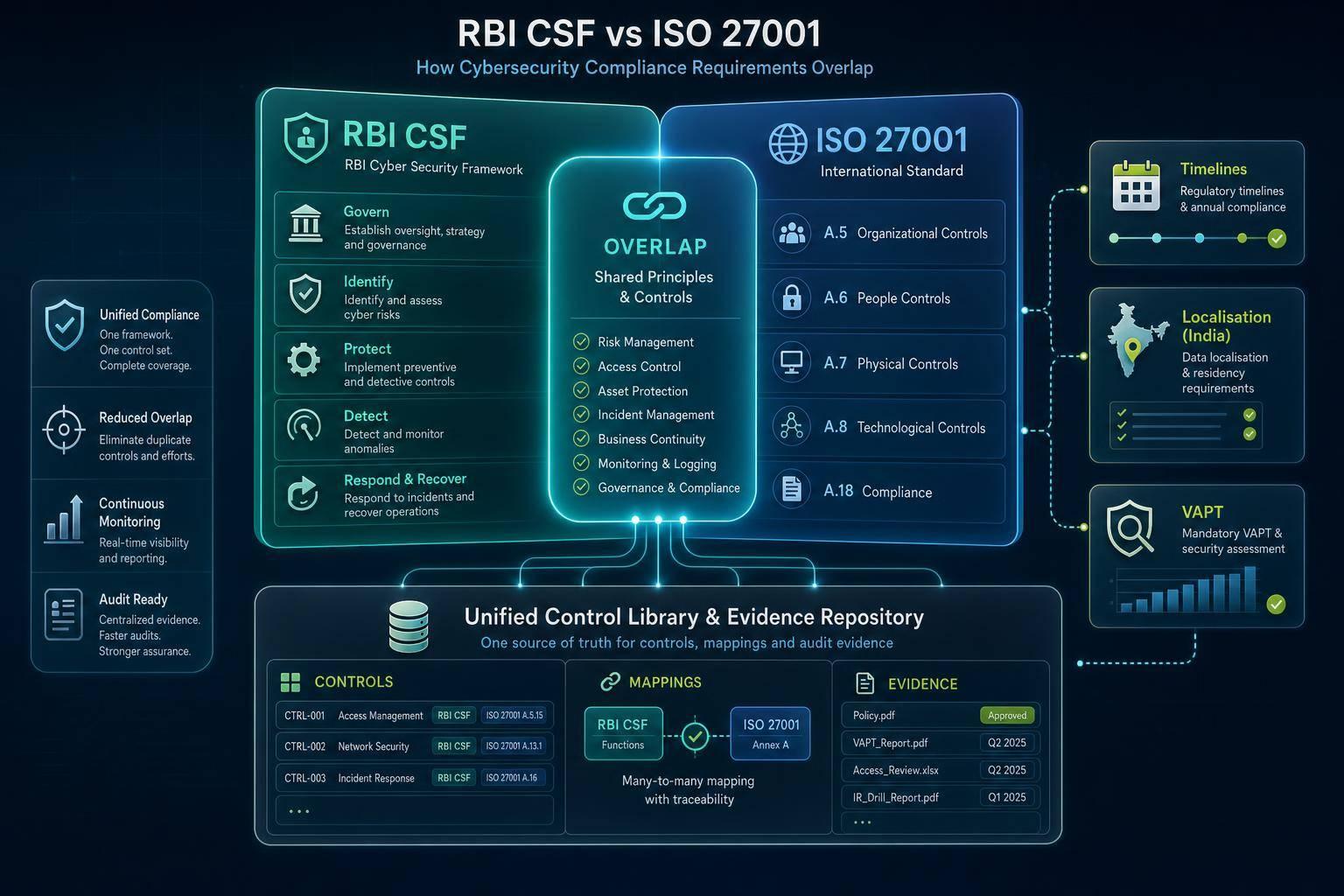
RBI CSF vs ISO 27001: How Cybersecurity Compliance Requirements Overlap
If you handle RBI CSF and ISO 27001 as two separate workstreams, you're likely doing the same compliance work twice. Treat them as one shared control set with RBI-only add-ons, because 80%+ of controls overlap in areas like access control, encryption, logging, vendor risk, incident response, and business continuity.
- ISO 27001 gives you the ISMS structure and risk-based control model.
- RBI CSF tells you what Indian regulated entities must do in fixed terms.
- The same evidence can often support both: access review logs, MFA records, asset registers, SIEM logs, DR test reports, vendor due diligence files, and incident tickets.
- But RBI is stricter on incident reporting within 2–6 hours, CISO separate from CIO, payments data stored in India, annual VAPT, patching SLAs (7 days critical / 30 days high), and log archival up to 5 years for some cases.
Operating model: Keep one control library, one evidence repository, and one governance review cycle — then add RBI-specific overlays where ISO 27001 does not go far enough.
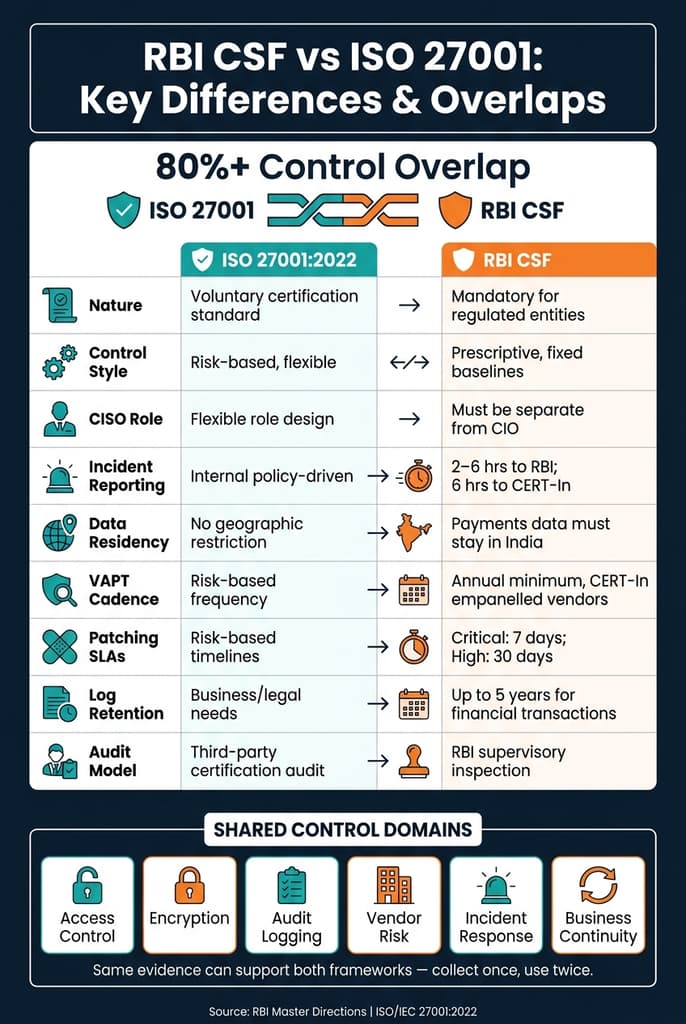
Quick Comparison
| Criteria | ISO 27001:2022 | RBI CSF / RBI Directions |
|---|---|---|
| Nature | Voluntary certification standard | Mandatory for regulated entities |
| Control style | Risk-based | More fixed and prescriptive |
| Governance | Flexible role design | CISO must be separate from CIO |
| Incident reporting | Based on internal process and law | 2–6 hours to RBI; 6 hours to CERT-In |
| Data residency | No location rule | Payments data must stay in India |
| Testing and patching | Based on risk | Annual VAPT, fixed patch timelines |
| Audit approach | Certification audit | Supervisory inspection |
In simple terms, ISO 27001 helps you organise the system, while RBI CSF tells you the non-negotiable rules. The overlap is large, but the gap areas matter a lot.
RBI CSF and ISO 27001: What Each Framework Is Designed to Do
RBI CSF in the Indian Regulatory Context
The RBI Cyber Security Framework is not a voluntary best-practice guide. It is a mandatory regulatory direction for banks, NBFCs, urban co-operative banks, payment aggregators, and other regulated financial entities in India. It pushes cyber resilience up to the boardroom — not something that sits only with the IT team.
RBI CSF is more prescriptive. It calls for an independent CISO, board-level reporting, a SOC, fast incident reporting, encryption baselines, and defined log retention. Regulators inspect these controls, and non-compliance can lead to penalties.
ISO 27001 as the ISMS Backbone
ISO/IEC 27001:2022 is a certifiable, risk-based ISMS standard using Plan-Do-Check-Act. Many organisations use it as the control spine for ISO 27001, SOC 2, DPDPA readiness, and other compliance programmes.
The idea is simple: select and map controls once, then reuse them across more than one framework. That saves duplicated work when teams are trying to meet audit, legal, and customer demands at the same time.
Where the Two Frameworks Align and Where They Differ
Both frameworks deal with governance, risk assessment, access management, incident response, and third-party oversight. There is an estimated 80%+ control overlap between ISO 27001, RBI frameworks, and the DPDPA Act in areas such as access management, encryption, and business continuity.
| Feature | ISO 27001:2022 | RBI CSF / Master Direction |
|---|---|---|
| Nature | Voluntary, certifiable international standard | Mandatory Indian regulatory framework |
| Control approach | Risk-based; controls selected via assessment | Prescriptive; specific baselines mandated |
| CISO role | Management-led ISMS; roles can be designed flexibly | Mandatory; must be separate from the CIO |
| Incident reporting | Based on internal policy and applicable laws | 2 to 6 hours to RBI; 6 hours to CERT-In |
| Data localisation | No specific geographic storage requirement | Payments data must be stored in India |
| Audit model | Third-party certification audit | RBI supervisory inspection |
Where RBI CSF and ISO 27001 Overlap in Practice
The overlap is direct: the same controls, evidence, and audit artefacts can often work for both frameworks. In day-to-day work, this shows up in governance, access, logging, incident response, resilience, and vendor oversight.
Governance, Risk Assessment, and Board Oversight
Both frameworks expect board-level oversight, clear accountability, and documented risk management. Run one quarterly steering committee that covers both RBI CSF governance and the ISO 27001 management review — the same meeting minutes can serve as evidence for both. One risk register and one treatment plan can support both programmes.
Access Control, Asset Management, Logging, and Incident Response
| Control Domain | RBI CSF Requirement | ISO 27001:2022 Reference | Shared Evidence That Can Be Reused |
|---|---|---|---|
| Access Control | MFA for privileged/remote access; quarterly access reviews | Annex A.5.15–A.5.18 | User access review logs, MFA configuration screenshots, joiner-mover-leaver tickets |
| Asset Management | Inventory of all business IT assets; data classification | Annex A.5.9–A.5.13 | Master asset register, data classification policy, disposal certificates |
| Logging & Monitoring | 180-day online log retention; 24×7 SOC | Annex A.8.15, A.8.16 | SIEM alerts, SOC incident logs, NTP synchronisation logs |
| Incident Response | 2–6 hour reporting to RBI; Cyber Crisis Management Plan | Annex A.5.24–A.5.28 | Incident logs, root cause analysis reports, CCMP test results |
You collect the evidence once, then use it twice. One incident playbook can support both frameworks, but it should include RBI notification templates and the 2–6 hour reporting timelines. Use the Incident Register to operationalise breach workflows and regulator-ready documentation.
RBI examiners now look for evidence chains, not certificates. Every claim must trace from policy to standard to operational artefact.
Resilience and Third-Party Risk Controls
RBI requires annual DR drills with documented RPO (≤4 hours) and RTO (≤8 hours) for critical systems. ISO 27001 Annex A.5.29 and A.5.30 cover the same area — one DR test report can support both if it records actual RTO/RPO results and stakeholder sign-off.
Both frameworks ask for vendor due diligence, security clauses in contracts, and continued oversight. RBI's Outsourcing Master Direction adds RBI inspection rights in contracts. Vendor Management centralises questionnaires, scoring, and supply chain oversight across both programmes.
Where RBI CSF Is More Prescriptive Than ISO 27001
ISO 27001 covers many RBI controls, but it doesn't meet RBI's fixed reporting timelines, governance rules, or India-specific obligations. A control may pass an ISO audit and still fail an RBI inspection.
Incident Reporting, Supervisory Reviews, and India-Specific Obligations
RBI requires cyber security incidents to be reported to its CSITE cell within 2 to 6 hours of detection, and to CERT-In within 6 hours. ISO 27001 is far less specific on timelines — you need pre-drafted reporting templates, automated alerting, and a 24×7 response workflow.
RBI also requires a standalone Cyber Security Policy separate from the broader IT or IS policy, and a CISO who is separate from the CIO with reporting one level below the MD/CEO. Track RBI, CERT-In, and DPDP duties in one obligations register.
Banking and Payments Controls That Need Extra Depth
Under RBI's April 2018 directive, payments data must be stored only in India. ISO 27001 does not place any geographic restriction on storage — cloud, backup, and DR design need a separate localisation review.
RBI also expects annual VAPT, evidence of manual exploit testing, and often CERT-In empanelled vendors. Critical vulnerabilities must be patched within 7 days, and high-severity issues within 30 days.
What This Means for Audit Evidence and Control Design
| Topic | RBI CSF Specifics | ISO 27001 Position | Compliance Implication |
|---|---|---|---|
| Incident Reporting | 2–6 hours to RBI; 6 hours to CERT-In | Timely reporting per internal ISMS procedures | Pre-approved templates and 24×7 alerting required |
| CISO Role | Mandatory; must be separate from CIO | Management responsibility; no role separation required | Distinct reporting lines and org chart evidence needed |
| Policy Structure | Cyber Security Policy must be separate from IT/IS policy | Unified ISMS policy framework acceptable | Requires a separate, board-approved cyber policy |
| Data Residency | Payments data must be stored only in India | No geographic restrictions | Cloud and backup architecture must be India-compliant |
| VAPT Cadence | Annual minimum; manual exploit testing; empanelled vendors | Risk-based frequency; no vendor mandate | Full reports and supporting artefacts required |
| Patching SLAs | Critical: 7 days; High: 30 days | Risk-based remediation timelines | Automated patch management and documented exceptions required |
| Log Retention | 5 years archived for financial transactions | Based on business and legal needs | Storage must support long-term archival at scale |
The operating model needs to be tight: one control library, one evidence repository, and RBI-specific overlays where needed. Run a gap assessment to map existing controls against both frameworks before audit season.
How to Cut Duplicate Compliance Work with a Unified Control and Evidence Model
The fix is simple on paper: one control model, one evidence model, and RBI-specific overlays only where needed.
Build a Shared Control Library and Evidence Repository
Name each control once and map it to every framework that applies. A single MFA policy for privileged access can map to ISO 27001 Annex A.5.17 and RBI Annex 1.8 — tag evidence when you collect it, not just before an audit. See multi-framework compliance monitoring for how unified mapping reduces duplicated work.
Use Continuous Compliance to Avoid Last-Minute Audit Pressure
Continuous compliance keeps audit readiness current instead of becoming a once-a-year scramble. An AI-native GRC platform like CISOGenie automates evidence collection, control mapping, and drift detection across RBI CSF, ISO 27001, SOC 2, and related frameworks.
| Operational issue | Reusable artefacts | How CISOGenie helps |
|---|---|---|
| Duplicate evidence requests | System logs; policy documents | Automated evidence workflows; one-click mapping to multiple frameworks |
| Prescriptive RBI gaps | Baseline controls (MFA, encryption) | AI-driven gap analysis highlighting India-specific obligations |
| Vendor risk silos | Vendor due diligence questionnaires; ISO/SOC certificates | Centralised vendor risk management with automated follow-ups |
Conclusion: Overlap Helps, but Mapping Must Stay Risk-Led
RBI CSF and ISO 27001 share enough common ground that a well-structured control library can cut duplicate work. RBI is more specific where it matters most — incident reporting timelines, CISO governance, data residency, and VAPT evidence. Teams that handle this well use one control library, one evidence repository, and RBI-specific overlays where needed. Follow a risk-led security management approach so mapping stays tied to actual exposure, not checkbox compliance.
Manual audit prep vs CISOGenieFrequently Asked Questions
Ready to unify RBI CSF and ISO 27001 compliance?
See how CISOGenie maps one control set across RBI CSF, ISO 27001, and 40+ frameworks — with automated evidence collection and India-specific gap analysis.